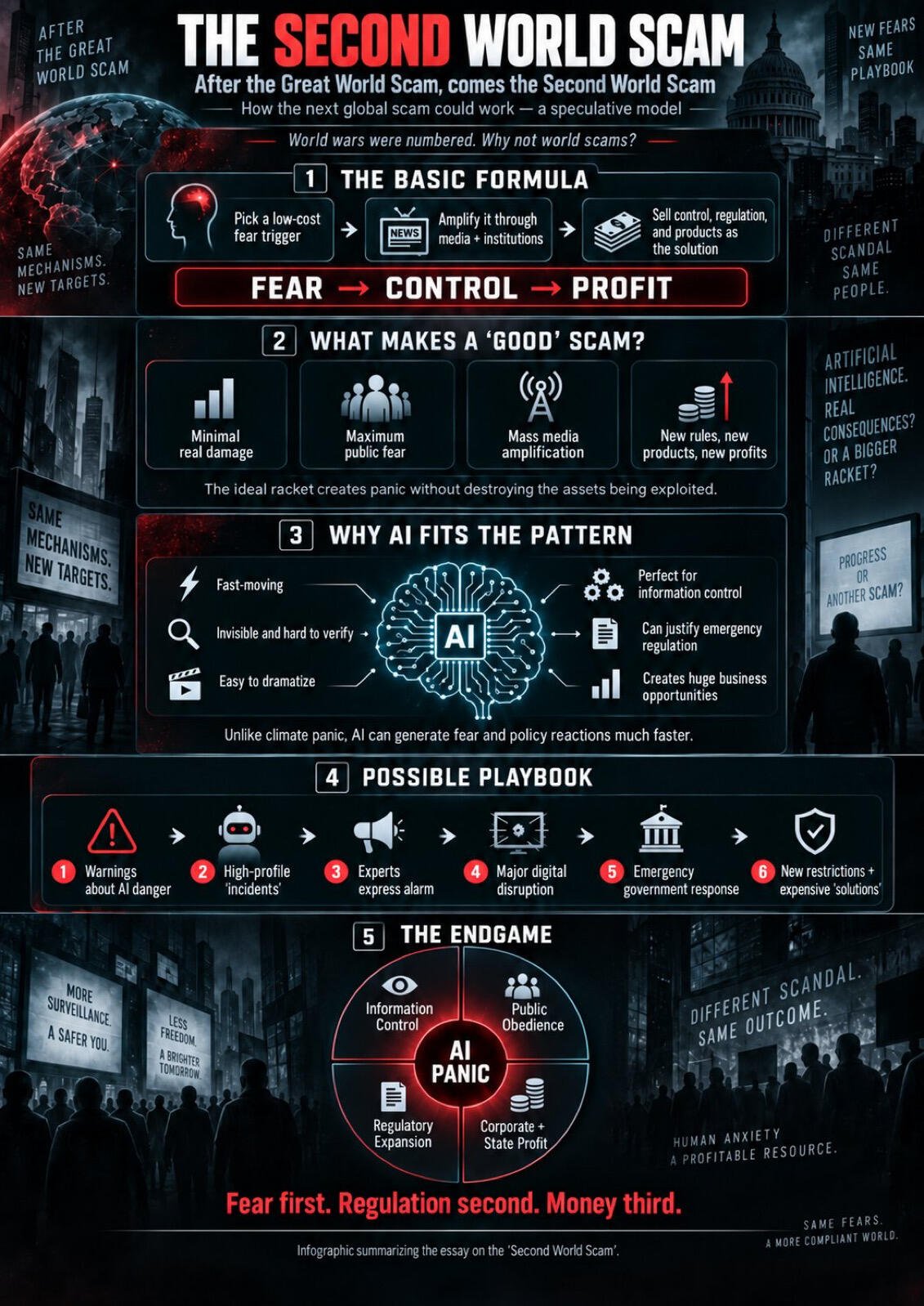
The Second World Scam.
We are living in an inter-scam era, much like Europeans once lived through the interwar period between World War I and World War II. There is a historical joke hidden in that comparison. What we now call World War I was originally known simply as the Great War. Nobody needed to number it because nobody expected there to be another one. Only after the Second World War did the first become the First World War. I suspect global scams may eventually follow the same naming convention.
We have already lived through what might be called the Great World Scam. If another global operation built on fear, mass propaganda, emergency regulation, and enormous transfers of money appears, the first one may have to be renamed retrospectively as the First World Scam. The new one would then earn the obvious title: the Second World Scam.
The Great World Scam was built around a respiratory virus that was dangerous enough to frighten people but nowhere near dangerous enough to justify the scale of the response. With an estimated mortality rate often cited around 0.15%, it was exactly the kind of threat that could be magnified into something apocalyptic without actually destroying the societies being subjected to the panic. The basic formula was simple: take a real phenomenon, exaggerate its scale, dominate the information environment, and then sell extraordinary measures as the only responsible solution.
If that formula worked once, there is no reason to assume nobody will try it again. The next scam would probably follow the same basic pattern, but it is unlikely to rely on another medical emergency. Too many people have already learned how that particular game works. A genuine pandemic might not create enough fear to justify vast new systems of control, while a truly catastrophic pandemic would cause too much real damage. The ideal racket needs panic without excessive destruction.
That distinction matters because you cannot milk a dead cow. Mass death is bad for business. It is far more profitable to keep the population alive, working, consuming, paying taxes, obeying regulations, and periodically surrendering more money and freedom in response to each new emergency. Governments do not need dead subjects. They need productive ones.
This is also why traditional wars are becoming a relatively clumsy instrument. Wars destroy factories, infrastructure, housing, trade networks, customers, taxpayers, and entire markets. They may still make sense for backward states that rely on conquest, theft, territorial expansion, and brute military force, but sophisticated states have more efficient methods. Why destroy wealth when you can redistribute it? Why invade people when you can frighten them into compliance? Why seize their property by force when they can be persuaded to surrender it voluntarily?
A modern scam therefore works best when the real damage is small but the psychological impact is enormous. It should create fear without destroying the assets being exploited. The perfect crisis produces new regulations, new industries, new subsidies, new bureaucracies, and new markets while leaving the underlying economic machinery largely intact. Fear first, control second, profit third.
Climate change is an obvious candidate for such a mechanism, but it has one major weakness: it is too slow. The fear campaign has to be sustained for decades, the alleged catastrophe remains permanently somewhere in the future, and the political and propaganda effort must be maintained continuously. Climate politics works better as a permanent ideological framework for expanding regulation and state power than as a fast, concentrated global racket capable of producing huge profits within a year or two.
A true Second World Scam would need something faster, more dramatic, and more difficult for ordinary people to understand independently. It would need a subject that could generate fear, emergency legislation, enormous procurement programs, new security systems, and entire regulatory industries in a very short period of time.
My candidate is Artificial Intelligence.
AI has almost everything required for a perfect global panic. It is real, powerful, rapidly developing, difficult to understand, and almost impossible for ordinary people to verify directly. Most people have no practical way to distinguish between what AI can actually do, what experts merely speculate it might do, and what journalists or politicians claim it could do. That uncertainty creates an ideal environment for fear.
The mythology is already being built. We are constantly hearing about AI becoming conscious, escaping human control, manipulating people, replacing humanity, taking over critical infrastructure, or eventually destroying civilization. The cultural templates are already familiar: Skynet, The Matrix, rogue robots, autonomous weapons, machines that become smarter than their creators. None of this has to be completely invented. The most effective propaganda rarely creates reality from nothing; it takes something real and changes its perceived scale.
AI is particularly useful because it concerns information itself. One of the clearest lessons of the COVID era was that whoever controls the information environment can largely control the public interpretation of events. AI can already be used to moderate speech, rank information, filter content, detect supposedly dangerous material, analyze behavior, identify people, manipulate feeds, and automate surveillance. In countries like Poland, authorities still sometimes rely on older tools such as police, prosecutors, intelligence services, and direct legal pressure. AI offers something much more elegant: automated control over the entire information ecosystem.
The Second World Scam could therefore begin gradually. First would come years of warnings from scientists, CEOs, politicians, military officials, journalists, and former AI researchers claiming that the technology may become uncontrollable. Then we would see a series of high-profile incidents: perhaps a self-driving car allegedly makes a lethal decision, a chatbot is accused of blackmailing someone, an AI system leaks private recordings, a trading algorithm triggers a market crash, or an autonomous weapon attacks the wrong target. Some of these incidents might be real, some exaggerated, and some perhaps staged. From the point of view of the narrative, the distinction would matter very little.
The next phase would be a wave of dramatic resignations and warnings from insiders. AI researchers could leave major companies and announce that they can no longer guarantee the safety of the systems they helped create. Executives could warn that humanity has built something it may no longer be able to control. Politicians would demand emergency legislation, while journalists would discover a new existential threat that requires constant coverage.
Eventually there would need to be the big event: something dramatic enough to convince millions of people that AI had effectively broken loose. The internet might begin malfunctioning, social media platforms could go offline, banking systems might become unstable, mobile networks could fail, data centers could stop responding, and power grids could experience unexplained outages. For several hours or several days, it could appear that digital civilization itself was collapsing.
The crucial point would be uncertainty. Ordinary people would have no way to know whether the disruptions were caused by AI, a cyberattack, sabotage, software bugs, human error, or something else entirely. In such an environment, whoever controls the official narrative would have enormous power to define what had happened and what measures were supposedly necessary.
Traditional television and radio would suddenly become extremely important again because governments would need reliable channels through which to broadcast emergency instructions, official explanations, and new regulations. Experts would appear on television to explain why extraordinary measures were unavoidable, while the public would be told to remain calm and trust the authorities.
Then would come the solution: mandatory “anti-AI” security software, government-certified operating systems, digital identity systems, licensing of advanced computing hardware, restrictions on open-source AI, mandatory monitoring of networks, registration of powerful computers, logging of AI activity, remote shutdown capabilities, government-approved models, restrictions on encryption, hardware-level control mechanisms built into processors, tighter state supervision of data centers, and perhaps even direct government control over strategically important semiconductor production.
Every one of those measures would create a new market. There would be new software, new hardware, new compliance departments, new licenses, new consultants, new subsidies, new agencies, new contractors, new taxes, new surveillance systems, and new fortunes. Once people had been convinced that the alternative was a machine-driven apocalypse, there would be almost no limit to the amount of money that could be extracted in the name of safety.
That is what makes AI such an interesting candidate. A Second World Scam would not need to invent Artificial Intelligence because AI already exists. It would only need to invent, exaggerate, or strategically reinterpret the catastrophe associated with it. A technical risk could become an existential threat, an accident could become a global emergency, and a temporary emergency measure could become permanent infrastructure.
Perhaps, then, we really are living in an inter-scam era. The Great World Scam is behind us, while the next one has not yet arrived. If it does, the naming convention will be obvious. The old one becomes the First World Scam, and the new one becomes the Second World Scam.
World wars were numbered. Why not world scams?
05.09.26