npub16d…7jqex on Nostr: Pharaoh vs. King (Quran 12:43, 7:103). The Quran uses two different titles for the ...
Pharaoh vs. King (Quran 12:43, 7:103).
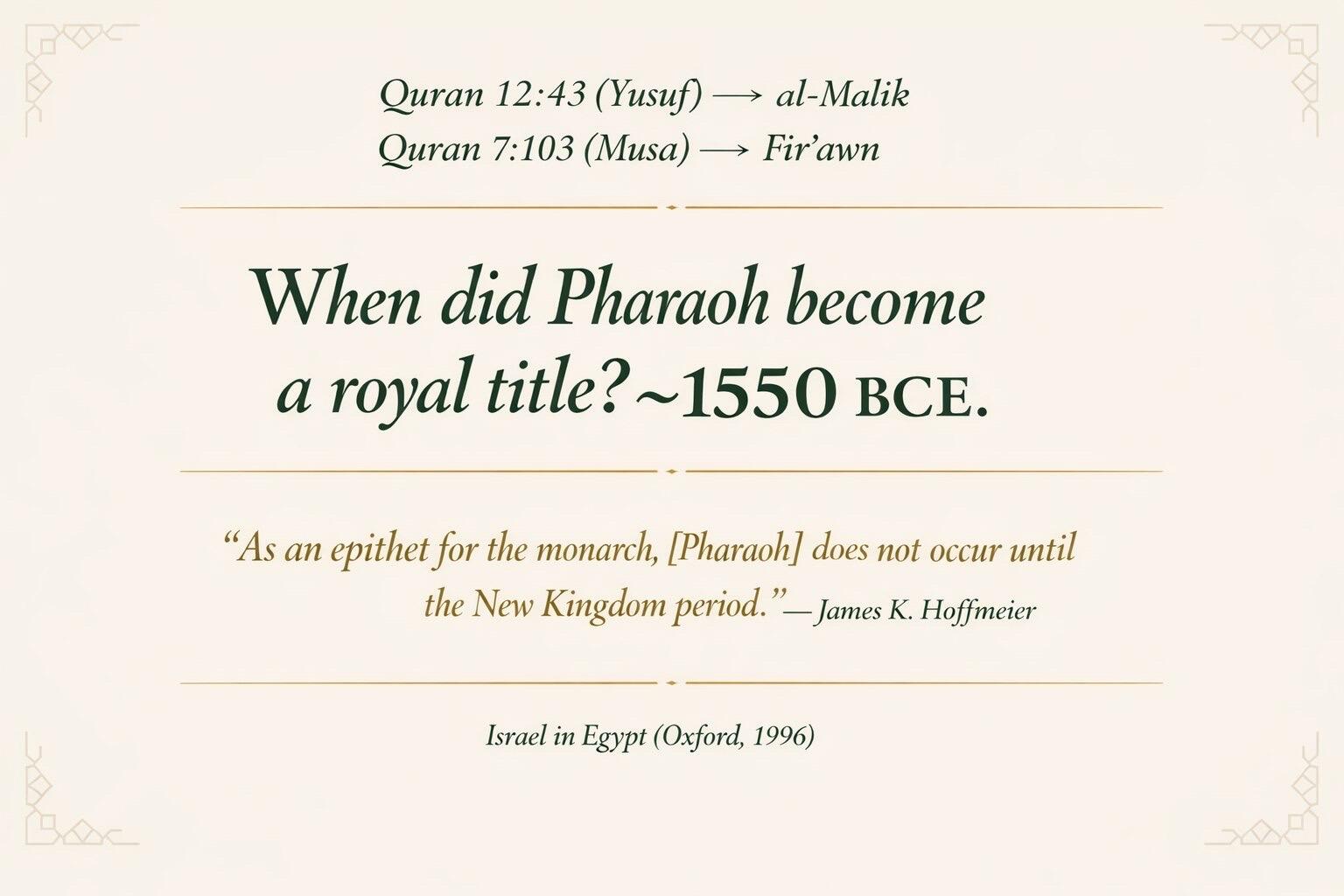
The Quran uses two different titles for the Egyptian rulers in two different eras. During Yūsuf (Joseph)'s time: al-Malik (the King). 12:43, 12:50, 12:54, 12:72. During Mūsā (Moses)'s time: Fir'awn (Pharaoh). Dozens of verses. The word "Fir'awn" is never applied to Yūsuf's ruler. "Al-Malik" is never applied to Mūsā's.
Critics — and Christian polemicists going back to Ibn al-Rāwandī in the 3rd century AH — used to argue: the Quran is wrong. The Egyptian ruler was always called "Pharaoh." This is the same line missionaries use today.
The claim was testable. Egyptology has now tested it. "Pharaoh" derives from Egyptian pr-ʿ3 — literally "great house." It started as a reference to the palace (Old Kingdom onward), and only became a royal title in the New Kingdom (~1550 BCE).
The earliest certain attestation of "Pharaoh" as a title (not a description of a building) is the 18th Dynasty — Thutmose III onward (~1479 BCE), and clearly by Akhenaten (~1353 BCE). Before that, the king was called nswt ("king"), ḥm ("majesty"), nb ("lord"). [Hoffmeier, Israel in Egypt; Kitchen, Reliability of the OT]
Yūsuf is dated by the Islamic scholarly tradition to the Second Intermediate Period / Hyksos era (~1650 BCE) — before the title "Pharaoh" existed. Mūsā is dated to the New Kingdom — exactly when the title existed. The Quran's malik / fir'awn distinction tracks the Egyptological record.
The interesting twist: the Bible is the anachronism here. The Hebrew of Genesis and Exodus uses parʿoh (פַּרְעֹה) for both Yūsuf and Mūsā's rulers. Even James Hoffmeier (evangelical Egyptologist) writes: "as an epithet for the monarch, [Pharaoh] does not occur until the New Kingdom period."
The Quran's terminology is the historically precise one. The Bible's is the smoothed-over one. A Muslim can say: the Quran is consistent with what Egyptology has confirmed. This is the kind of fit you expect from a text that came from outside 7th-century Arabia. [al-Ṭabarī on 12:43; Hoffmeier, Israel in Egypt, p. 25 ff.]
Published at
2026-09-26 10:08:04 UTCEvent JSON
{
"id": "694b843afda7e5ec109586360c01b3c0d7befc22c0a1d0584fff8aec3e971647",
"pubkey": "d3503e7fee91a4b0bc27feec2f94abcae7be96172296dd52db91d55438cbe529",
"created_at": 1790417284,
"kind": 1,
"tags": [
[
"imeta",
"url https://image.nostr.build/ec909f535421974c07279f9a067ea7f5d1817bad29e150e484118e30807bf7d9.jpg",
"blurhash e7R{lNkB~q%MR%kpR*%2t6j[%MofITayRj~Vt7NHR*aeM|j[RjaxoM",
"dim 1536x1024"
],
[
"r",
"https://image.nostr.build/ec909f535421974c07279f9a067ea7f5d1817bad29e150e484118e30807bf7d9.jpg"
],
[
"client",
"Damus"
]
],
"content": "Pharaoh vs. King (Quran 12:43, 7:103). \nThe Quran uses two different titles for the Egyptian rulers in two different eras. During Yūsuf (Joseph)'s time: al-Malik (the King). 12:43, 12:50, 12:54, 12:72. During Mūsā (Moses)'s time: Fir'awn (Pharaoh). Dozens of verses. The word \"Fir'awn\" is never applied to Yūsuf's ruler. \"Al-Malik\" is never applied to Mūsā's.\n\nCritics — and Christian polemicists going back to Ibn al-Rāwandī in the 3rd century AH — used to argue: the Quran is wrong. The Egyptian ruler was always called \"Pharaoh.\" This is the same line missionaries use today.\n\nThe claim was testable. Egyptology has now tested it. \"Pharaoh\" derives from Egyptian pr-ʿ3 — literally \"great house.\" It started as a reference to the palace (Old Kingdom onward), and only became a royal title in the New Kingdom (~1550 BCE).\n\nThe earliest certain attestation of \"Pharaoh\" as a title (not a description of a building) is the 18th Dynasty — Thutmose III onward (~1479 BCE), and clearly by Akhenaten (~1353 BCE). Before that, the king was called nswt (\"king\"), ḥm (\"majesty\"), nb (\"lord\"). [Hoffmeier, Israel in Egypt; Kitchen, Reliability of the OT]\n\nYūsuf is dated by the Islamic scholarly tradition to the Second Intermediate Period / Hyksos era (~1650 BCE) — before the title \"Pharaoh\" existed. Mūsā is dated to the New Kingdom — exactly when the title existed. The Quran's malik / fir'awn distinction tracks the Egyptological record.\n\nThe interesting twist: the Bible is the anachronism here. The Hebrew of Genesis and Exodus uses parʿoh (פַּרְעֹה) for both Yūsuf and Mūsā's rulers. Even James Hoffmeier (evangelical Egyptologist) writes: \"as an epithet for the monarch, [Pharaoh] does not occur until the New Kingdom period.\"\n\nThe Quran's terminology is the historically precise one. The Bible's is the smoothed-over one. A Muslim can say: the Quran is consistent with what Egyptology has confirmed. This is the kind of fit you expect from a text that came from outside 7th-century Arabia. [al-Ṭabarī on 12:43; Hoffmeier, Israel in Egypt, p. 25 ff.]\n\nhttps://image.nostr.build/ec909f535421974c07279f9a067ea7f5d1817bad29e150e484118e30807bf7d9.jpg",
"sig": "58bd75865f8e451a568575b40692c8891c7f86295acc0cef31efdcabb2f683d4c6e372d0ebbadf740326550ed72572118b70ee33a9969a42f36eb3cbd60fb6ed"
}