Event JSON
{
"id": "e1f55da3649381ba7261d43c2908535e99b343ecf47c00fbcb94dc24d2e7669f",
"pubkey": "2212342b0e8fe5af7756b6deac8f58f9b64367a6a2c3d2d2802a569fd264acc4",
"created_at": 1790223444,
"kind": 1,
"tags": [
[
"t",
"pacific"
],
[
"t",
"weather"
],
[
"proxy",
"https://alaskan.social/@AlaskaWx/117324083637079480",
"web"
],
[
"imeta",
"url https://alaskansocial.files.fedi.monster/media_attachments/files/117/324/036/456/177/972/original/46eaa97f4b7ecc52.png",
"m image/png"
],
[
"proxy",
"https://alaskan.social/users/AlaskaWx/statuses/117324083637079480",
"activitypub"
],
[
"L",
"pink.momostr"
],
[
"l",
"pink.momostr.activitypub:https://alaskan.social/users/AlaskaWx/statuses/117324083637079480",
"pink.momostr"
],
[
"-"
]
],
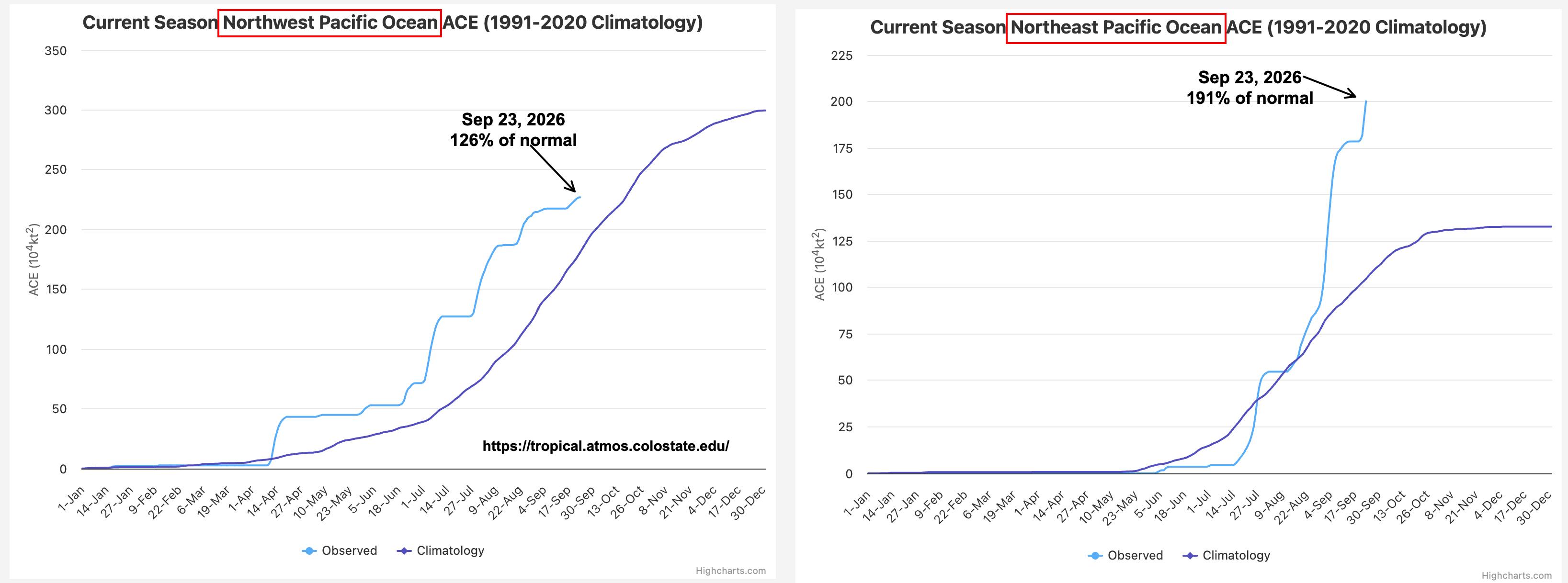
"content": "Nerd alert: through Sept 23, Accumulated Cyclone Energy (a measure of overall tropical storm activity) in the western Pacific from the dateline to Asia is above normal but not dramatically so. However, in the eastern Pacific (dateline to North American), ACE is through the roof, almost double the 1991-2020 normal. Graphics courtesy Colorado State University. #weather #Pacific\nhttps://alaskansocial.files.fedi.monster/media_attachments/files/117/324/036/456/177/972/original/46eaa97f4b7ecc52.png\n",
"sig": "e606e3028d9b8f4267292a9e37d68380d6bad318da8d61f4c9691aa45f469399e5147351afb480ada0f54b2d151b962c57035613ec8d30aa1c5c6c7c4716ac06"
}