

After attending bitcoin++ Berlin, payments edition, two talks have been stuck in my head.
Allen Farrington’s [The Fiat Payment Stack Returns (Part 2), The Sequel](https://btcpp.dev/berlin26#berlin26_fiat_bf4b) explored how complicated fiat payments are underneath the familiar experience of tapping a card.
Then Lightrider’s [It Worked on My Node](https://btcpp.dev/berlin26#berlin26_worked_c209) showed us real numbers from nadanada.me. Once they added credit cards, Monero, shitcoins, and stablecoins, Bitcoin payments became a minority. And lightning is now just 10% of their payments.
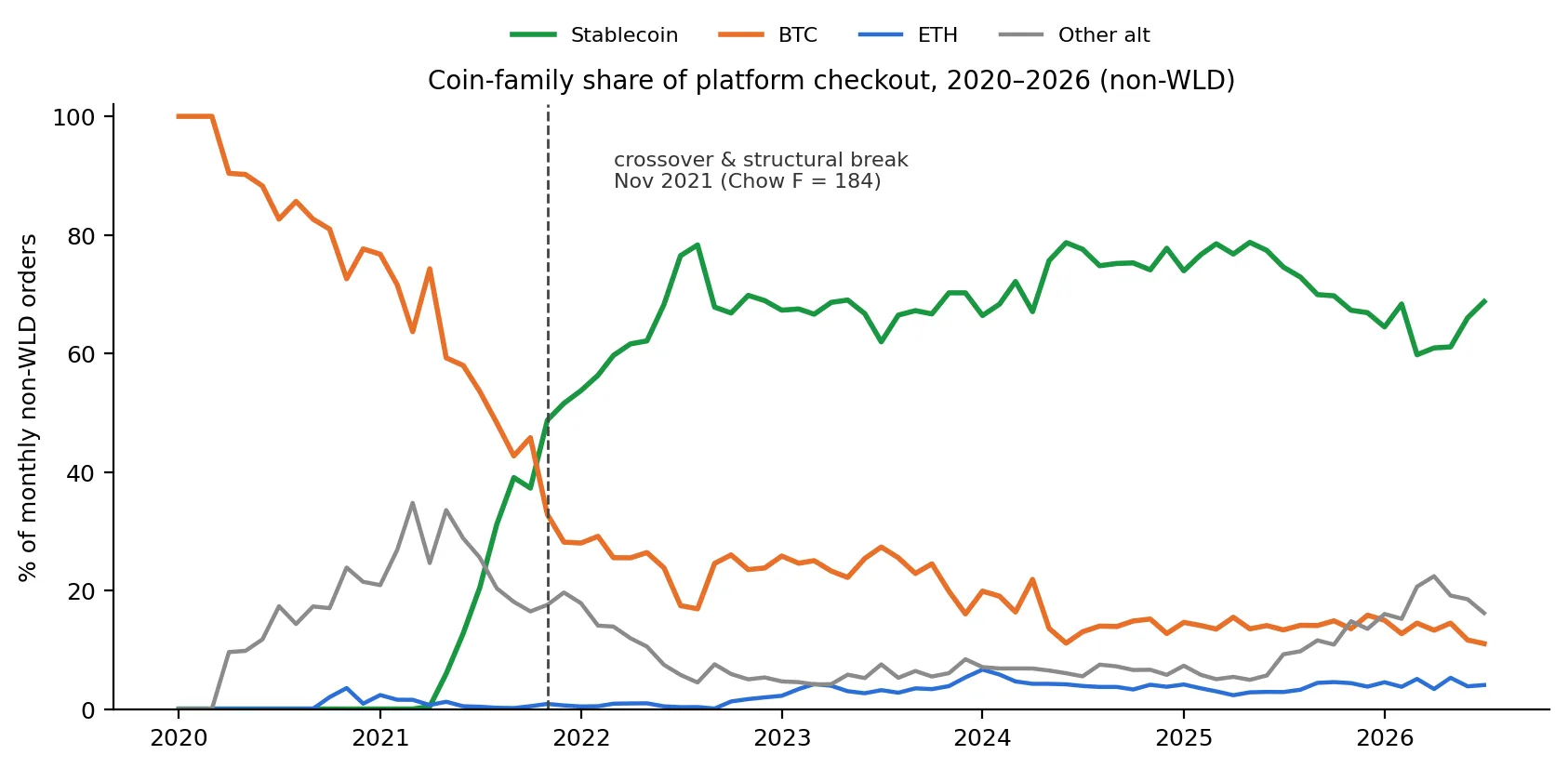
Cryptorefills’ checkout data tells a similar story: stablecoins overtook Bitcoin in 2021 and now account for roughly two thirds of completed purchases on its platform.
I recommend watching both when the recordings are published. Together, they left me with an uncomfortable thought: the payment system we want to replace is a mess, yet people still aren’t choosing ours. I think we should take that seriously.
Bitcoin is a miracle. We have scarce digital money that we can hold under our own keys, without a bank deciding whether we deserve access. Nobody gets to print more. That is extraordinary.
We have won something enormous: the ability to save outside the banking system. I remain very bullish. Bitcoin is volatile, but my bet over the long run is still up and to the right.
But we haven’t won everyday payments. And perhaps we’ve spent too much time treating those as the same problem.
You might be happy to hold bitcoin through volatility. But a merchant trying to pay wages and suppliers may not be. Accepting bitcoin and wanting to keep bitcoin are different decisions. Meanwhile, a customer’s card is familiar, costs nothing to the user, and works everywhere.
If they choose that, it's not because they are "dumb". They’re solving their problems.
If we believe in free markets, the market gets to disagree with us. We should be curious about what people want, and build something worth choosing.
There is plenty to improve. Visa and Mastercard payments involve issuers, acquirers, processors, networks, currency conversion, and reconciliation. Merchants pay for that machinery, and the fees hurt when margins are thin. International transfers can be worse: in the third quarter of 2025, sending a $200 remittance cost 6.36% on average globally. Almost $13 just to move $200.
Stablecoins give people something immediately useful: familiar money that can move over an open network. For someone with an unstable local currency, limited banking access, or customers abroad, a digital dollar can solve a real problem today. Just like Bitcoin, but with less volatility.
Yes, stablecoins are fiat squared. You inherit fiat’s problems and add an issuer who can fail, restrict redemption, or freeze your tokens. But people are comparing them with the bank accounts and payment services they actually have. We should do the same.
I’m also unconvinced that CBDCs are the inevitable future. Several early launches have struggled to attract meaningful use. Governments can launch a product; they can’t manufacture a reason to want it.
My bet is that stablecoins will become the dominant way money moves across the internet, eventually taking over much of what card networks do today. People may still tap cards. Visa and Mastercard may adapt and thrive. The interface can stay familiar while the money underneath changes.
I often see Paolo Ardoino depicted as evil in Bitcoin circles. I don't know if he is. But what matters is whether he is right about stablecoins. And he might be.
Which brings me to the part that excites me: those dollars could move over Lightning.
What's the best "house" for stablecoins? There are many blockchains available. And looks like Tron is winning. Then Ethereum, Solana, Binance, ... So it's not like their users appreciate security and decentralization the most. Running a full node for any of those requires expensive equipment. Apart from other issues like PoS and even shittier version of that that give control to a handful or operators. But they are cheap. Big blocks, coming out every few seconds.
But blockchains don't scale. So if the whole world population would be using stablecoins, none of those would be able to keep up. At least without becoming a centralized database which might be too much even for the most careless shitcoiners.
But we have already solved that! No blockchain will be ever capable of competing with a channel based payments network like lightning. In terms of throughput and fees. So maybe Lightning is the best "house" for stablecoins after all.
Payment channels let us make many payments without recording every one on a global ledger. Bitcoin provides the foundation, while payments happen across a network of channels. I think that is a powerful architecture for global payments.
With Taproot Assets, a dollar payment can be exchanged into bitcoin at one edge, routed through Lightning, and exchanged into the recipient’s asset at the other. The customer can spend dollars. The merchant can receive dollars. Bitcoin can connect them without either having to share our monetary convictions.
Somebody has to provide liquidity and make the exchanges worthwhile. But the architecture is real. Tether has announced plans to bring USDt to Bitcoin and Lightning through Taproot Assets. I think we should be paying attention.
And honestly once on Lightning, the interoperability of Taproot assets with real bitcoin makes it too easy to switch. So that's another win there. Would be way easier to go from stablecoins to bitcoin than from fiat in a bank account to bitcoin, which is the current baseline.
The difficult part will be making it pleasant to use.
Self-custodial Lightning still involves channels, liquidity, backups, and recovery. We can improve that experience, but wishing everyone would run their own infrastructure won’t make it happen.
Some people will choose a provider. Others will want their own keys. Tools like Cashu offer another useful possibility: private ecash, backed by a mint the user trusts. That involves custody, but can offer privacy that an ordinary payment account doesn’t.
I can imagine wallets, mints, and payment companies connected through Lightning, competing to serve people who want to spend different kinds of money. What matters is whether users can move between them, withdraw their funds, recover from mistakes, and take more control when they want to.
Max Hillebrand’s The Praxeology of Privacy helped me think about this. I take from it an emphasis on practical progress toward autonomy. We don’t have to wait for everyone to adopt our ideal setup before helping them become freer.
Freedom comes before Bitcoin.
Bitcoin matters because of what it lets people do. If someone wants dollars for spending, I want to help them use dollars with lower costs, better privacy, and more choice. If they later want sovereign savings, Bitcoin should be within reach. The immediate benefit should be theirs, not our satisfaction at having converted another person.
I might be wrong about stablecoins winning, or Lightning becoming their best network. The honest way to find out is to listen, build, and compete.
Bitcoin has given people an extraordinary way to save. Now let’s give them better ways to spend, with useful wallets, private payments, and services they can leave as easily as they can join.