npub1ap…f5l75 on Nostr: **Astronomy Picture of the Day** 21 September 2026 **Cocoon Nebula Wide Field** ...
**Astronomy Picture of the Day**
21 September 2026
**Cocoon Nebula Wide Field**
Image:
Credit: Not provided
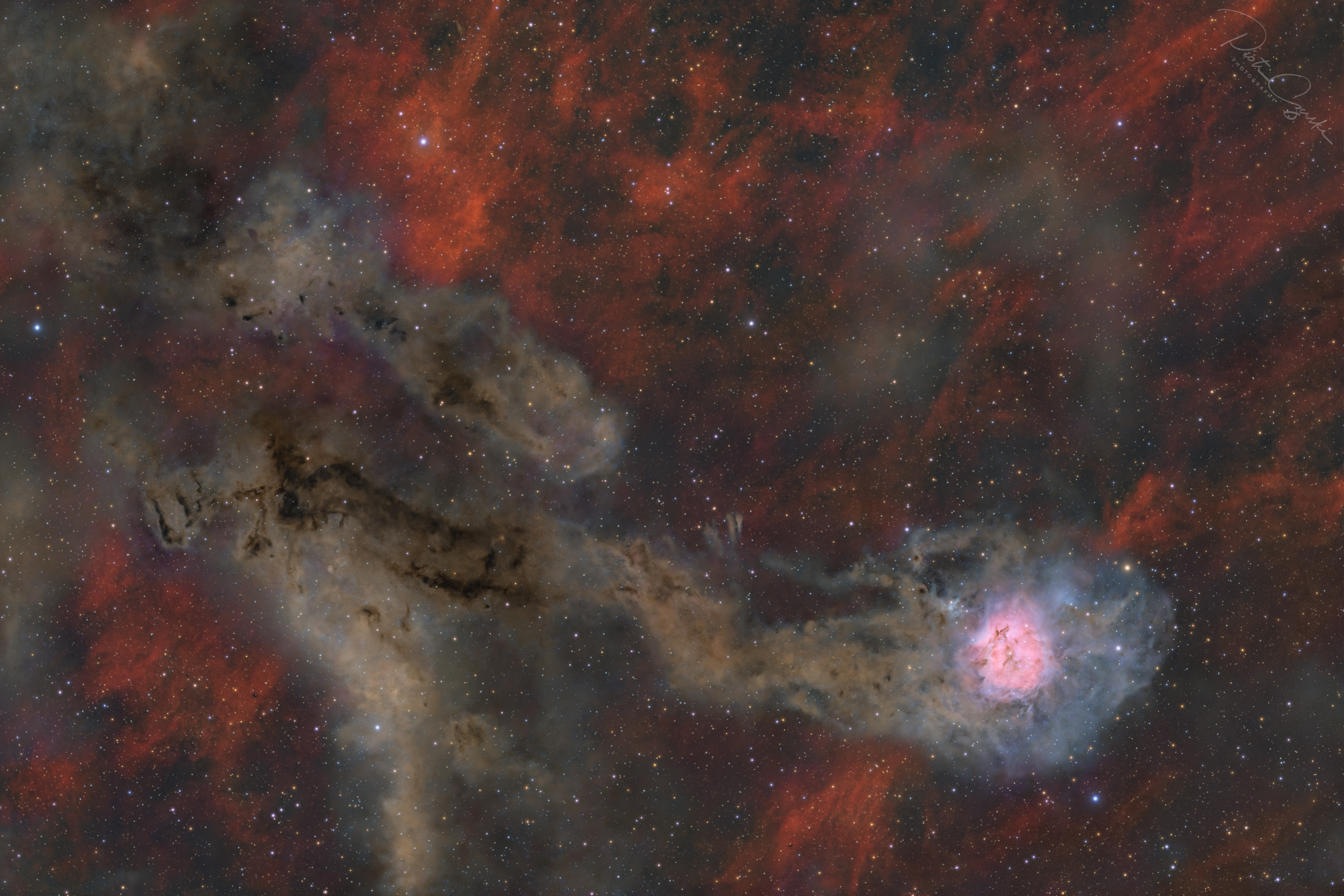
When does a nebula look like a comet? In this crowded starfield covering over two degrees within the high-flying constellation of the Swan ( Cygnus ), the eye is drawn to the Cocoon Nebula. A compact star forming region, the cosmic Cocoon punctuates a nebula bright in emission and reflection on the lower right, with a long trail of interstellar dust clouds to the left, making the entire complex appear a bit like a comet . Cataloged as IC 5146 , the central bright head of the nebula spans about 10 light years , while the dark dust y tail spans nearly 100 light years. Both are located about 2,500 light years away. A bright star near the colorful nebula's center likely supplies power and helps clear out a cavity. The long dusty filaments of the tail, although dark in this visible light image, hide stars in the process of formation . The featured image was captured in July from Death Valley , California , USA .
#APOD #CocoonNebula #IC5146 #Cygnus #Nebulae #StarFormation
https://apod.nasa.gov/apod/ap260921.htmlPublished at
2026-09-21 04:10:40 UTCEvent JSON
{
"id": "f9e24b6a20cd9a6637756dc22b73710537264190c9b279d2cc6865b56963dbd5",
"pubkey": "e85ed75286cb77475776c1007df8c4ff1c9c68eff91c3627347b065c5bf4dc78",
"created_at": 1789963840,
"kind": 1,
"tags": [],
"content": "**Astronomy Picture of the Day**\n\n21 September 2026\n\n**Cocoon Nebula Wide Field**\n\nImage: https://apod.nasa.gov/apod/image/2609/Cocoon_Czerski_3000.jpg\n\nCredit: Not provided\n\nWhen does a nebula look like a comet? In this crowded starfield covering over two degrees within the high-flying constellation of the Swan ( Cygnus ), the eye is drawn to the Cocoon Nebula. A compact star forming region, the cosmic Cocoon punctuates a nebula bright in emission and reflection on the lower right, with a long trail of interstellar dust clouds to the left, making the entire complex appear a bit like a comet . Cataloged as IC 5146 , the central bright head of the nebula spans about 10 light years , while the dark dust y tail spans nearly 100 light years. Both are located about 2,500 light years away. A bright star near the colorful nebula's center likely supplies power and helps clear out a cavity. The long dusty filaments of the tail, although dark in this visible light image, hide stars in the process of formation . The featured image was captured in July from Death Valley , California , USA .\n\n#APOD #CocoonNebula #IC5146 #Cygnus #Nebulae #StarFormation\n\nhttps://apod.nasa.gov/apod/ap260921.html\n",
"sig": "304f993f49c04227596fd6052e630953f16ac7255ada3144d090d782c78bb55dee9e1ea6f7d9e41939812f2876c79f27cb97b3edb66f33170f121e60df86dea4"
}