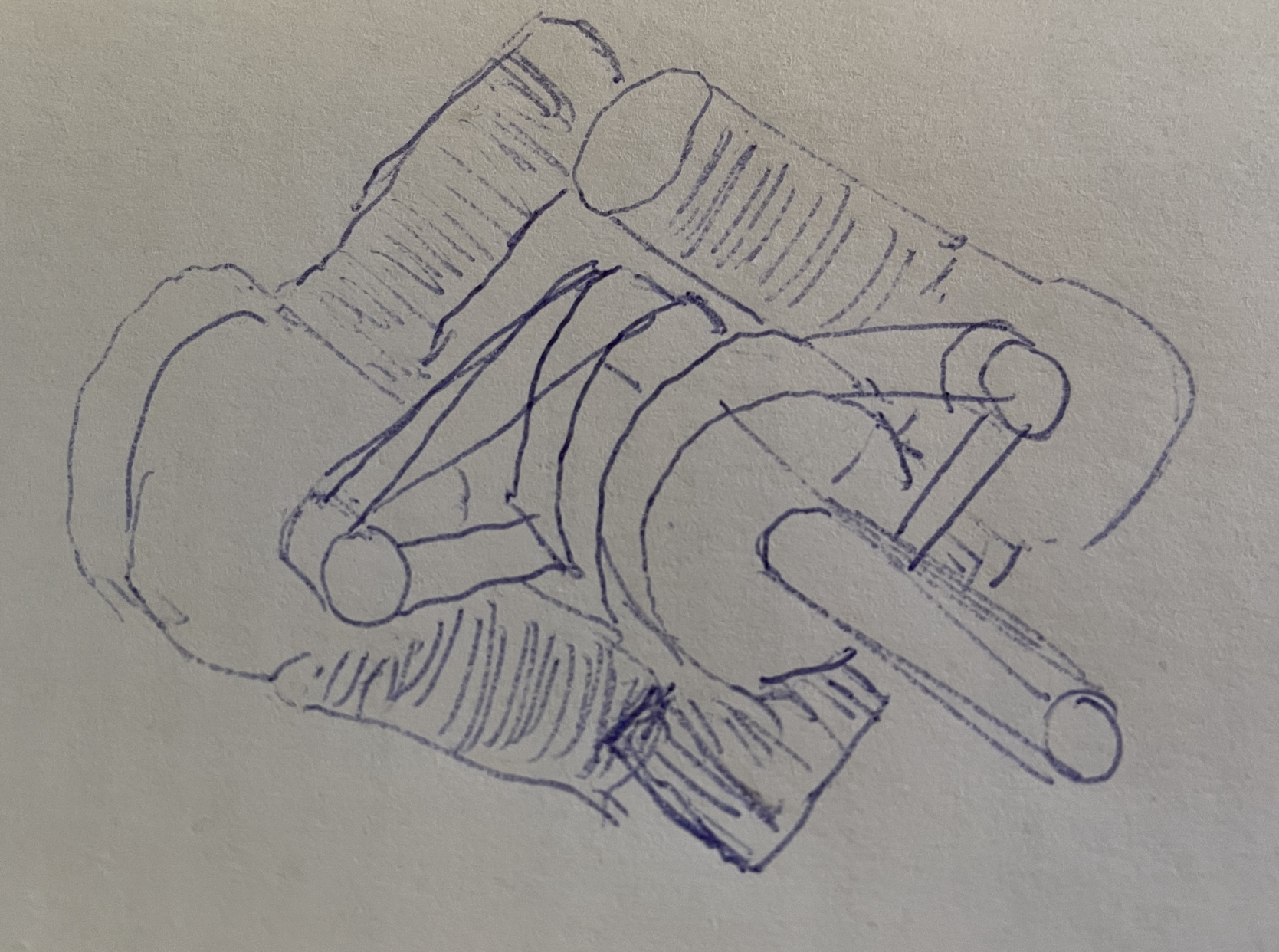
Earlier I was thinking about a low speed v-twin with Atkinson valve timing. But I just realized that it's a much smarter idea to go with a stack of independent engines which belt to a common propeller shaft. (Bad drawing related)
I've got V engines turned 90 degrees sideways, and the prop shaft runs through the center. They're interleaved on the right and left side of the prop shaft so that the belt and pulley of each engine fits inside of the V of the engine in front of it - this allows for tighter packing.
Each of the main pulleys is on a sprague clutch or breakaway mechanism so that if an engine completely locks up (e.g. seized, thrown rod, ...) the other rest of the system continues functioning without it.
It's easy to think of this as unnecessary weight because the engines have no shared components, and it's just "fear based over-engineering", but I claim it can have even better power-to-weight than a classical design because the redundancy allows you to go to RPM and turbo boost pressures that would be considered too dangerous otherwise.
And once you build one engine module (say 80hp), you now have 50hp (de-tuned because no redundancy), 160hp, 240hp, and 320hp. You can go beyond that if you want to, but the stack gets long.
I think if I had to pick my favorite powertrain, I would skip the micro-turbines because while they are very cool and very capable, they're just irreducibly expensive.
Good battery technology is obviously very exciting - as an area of research - but it's not something specific to flight.
If I had to give it to someone, I'd give it to something "dumb" - bolting an internal combustion engine to a generator and then using that to drive a quadcopter.
It's "dumb" because you have a generator (weight) to convert mechanical power to electrical power (inefficient) to then send it to a motor (more weight) to convert it back to mechanical power (more inefficiency).
And the reason why I want to call it out is because it's exactly that "dumb" thing that nobody thinks to try, because it's "dumb".
But now the reason why it's actually smart is because it allows an internal combustion engine to be a drop-in replacement for a battery.
The reason why it's smart is because there's an entire ecosystem around electrical propulsion. Motors, motor controllers, flight control units, etc are all being built and perfected around electricity and batteries. Anything that takes you back to shafts or other mechanical drive mechanisms risks putting you alone in your own little corner.
He was swapping between engine and battery and doing runs with both. He said the engine is a little bit heavier than the battery, but has better range.
IMO this is really smart because he's able to see past the obviousness of it being dumb.